
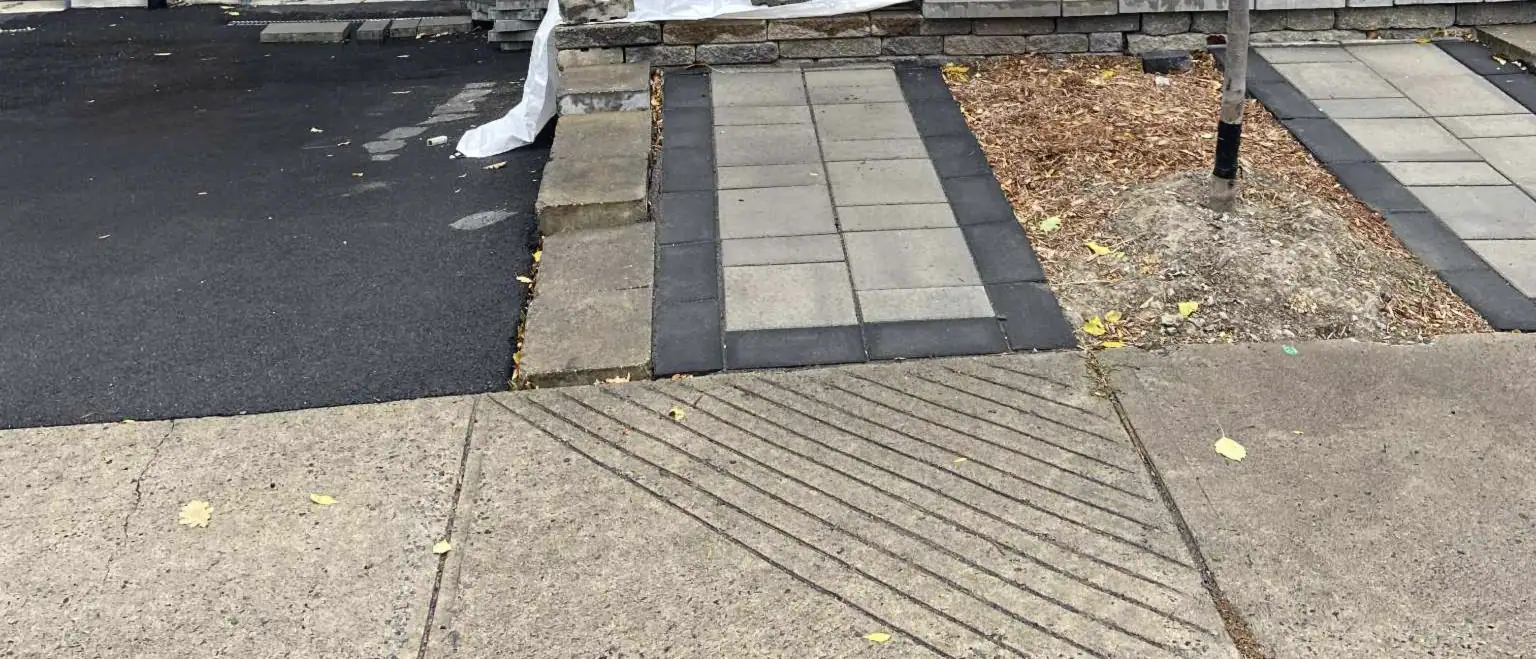
Interlocking pavers or asphalt for your driveway?
Asphalt generally costs less to install and goes down faster, which makes it a practical choice for a simple, functional driveway. Interlocking pavers require a higher upfront investment, but they offer more design options and can be repaired one stone at a time. Either way, how long your driveway lasts depends mostly on the granular base and the drainage. The right choice comes down to your budget, the style of your home and how much maintenance you're comfortable with.
Many West Island homeowners, from Kirkland to Sainte-Anne-de-Bellevue, face this question when it's time to redo the driveway. Here's an honest, side-by-side comparison.
Look and style
Pavers come in a wide range of shapes, colours, textures and patterns. They let you create borders, curves and layouts that complement the brick or stone of your home. You can also carry them into a walkway, a patio or garden edging for a cohesive look.
Asphalt keeps things simple: a smooth, uniform black surface. Well maintained, it looks clean and tidy and suits most homes. It does fade over the years, which is where sealcoating comes in to restore its colour.
Upfront cost and installation time
Asphalt is generally the less expensive option to install. Once the base is ready, paving is mechanized and quick, and the driveway can be used after a few days of curing.
Pavers generally require a bigger investment. Every stone is laid by hand, there are plenty of cuts around curves and obstacles, and the preparation has to be very precise to get a flat, even surface. The job also takes longer. Timing can matter too: if you need your driveway back quickly, asphalt generally means less time parking elsewhere.
To compare fairly, look beyond the initial price. Maintenance, repairs and the lifespan of the surface are all part of the equation.
Maintenance and repairs
Both surfaces need some attention, just not the same kind:
- Asphalt: sealcoating roughly every 2 to 3 years, depending on wear, plus filling cracks as soon as they appear. Patches over potholes or sunken areas often remain visible.
- Pavers: topping up the polymeric sand in the joints as needed, occasional weeding and, if an area sinks, lifting and relaying the affected pavers after correcting the base.
When it comes to repairs, pavers have the edge. A stained, cracked or sunken paver can be lifted out and replaced individually, with hardly a trace. Asphalt is repaired in sections, and the difference in colour between old and new only fades with time. Pavers also make sense if underground work might be needed later, such as a French drain replacement: they can be removed and reinstalled once the work is done.
Practical tipOnce your pavers are installed, keep a few extras tucked away in the shed or garage. Colours vary from one production batch to the next, so matching pieces will make any future repair much less noticeable.
How they handle winter
In our climate, both surfaces go through freeze-thaw cycles. Asphalt is flexible and dark, so it warms up quickly in the sun. Over time, though, it can crack, and water seeping into those cracks widens them from one winter to the next.
Thanks to their joints, pavers can handle slight movement without cracking. But if the base doesn't drain well, frost can lift some pavers and create uneven spots. De-icing salt can also wear the surface of certain pavers, so follow the manufacturer's recommendations. With either surface, a proper slope keeps water from sitting and freezing on top.
The base: the real secret behind both
Asphalt or pavers, what you can't see is what determines how long your driveway lasts. A crushed-stone base of sufficient depth, compacted in layers, and a slope that carries water away from the house are essential. A beautiful surface laid on a poorly prepared base will eventually ripple, crack or sink.
The clay soils found across the West Island make this step even more important. At S&L, pavers are laid on a compacted granular base with careful attention to drainage, and the same thinking guides site preparation before asphalt paving.
Why not both?
Many homeowners go for a combination: an asphalt driveway framed with paver borders. The borders define the surface, add character and tie the driveway to walkways, steps or a patio, generally at a lower cost than an all-paver driveway.
Others keep pavers for the most visible areas, like the path to the front door or the patio, and use asphalt where the cars go. A mixed design can also be done in stages, starting with the asphalt and adding paver borders or a walkway later, as long as the plan accounts for it from the start.
Because S&L works with both asphalt and pavers, the two options can be compared on your own property, then combined if needed for a driveway that's attractive, practical and durable.
Frequently asked questions
Are interlocking pavers more expensive than asphalt?
Generally, yes. Pavers are laid by hand and need more precise preparation, while asphalt goes down faster. Maintenance and repairs should also be part of the comparison.
What maintenance does a paver driveway need?
Topping up the polymeric sand in the joints as needed, occasional weeding and relevelling any area that sinks. A damaged paver can be replaced individually.
Can asphalt and pavers be combined in the same driveway?
Yes. An asphalt driveway with paver borders is a common option that adds character while keeping costs down. Both surfaces need a well-compacted, well-drained base.


